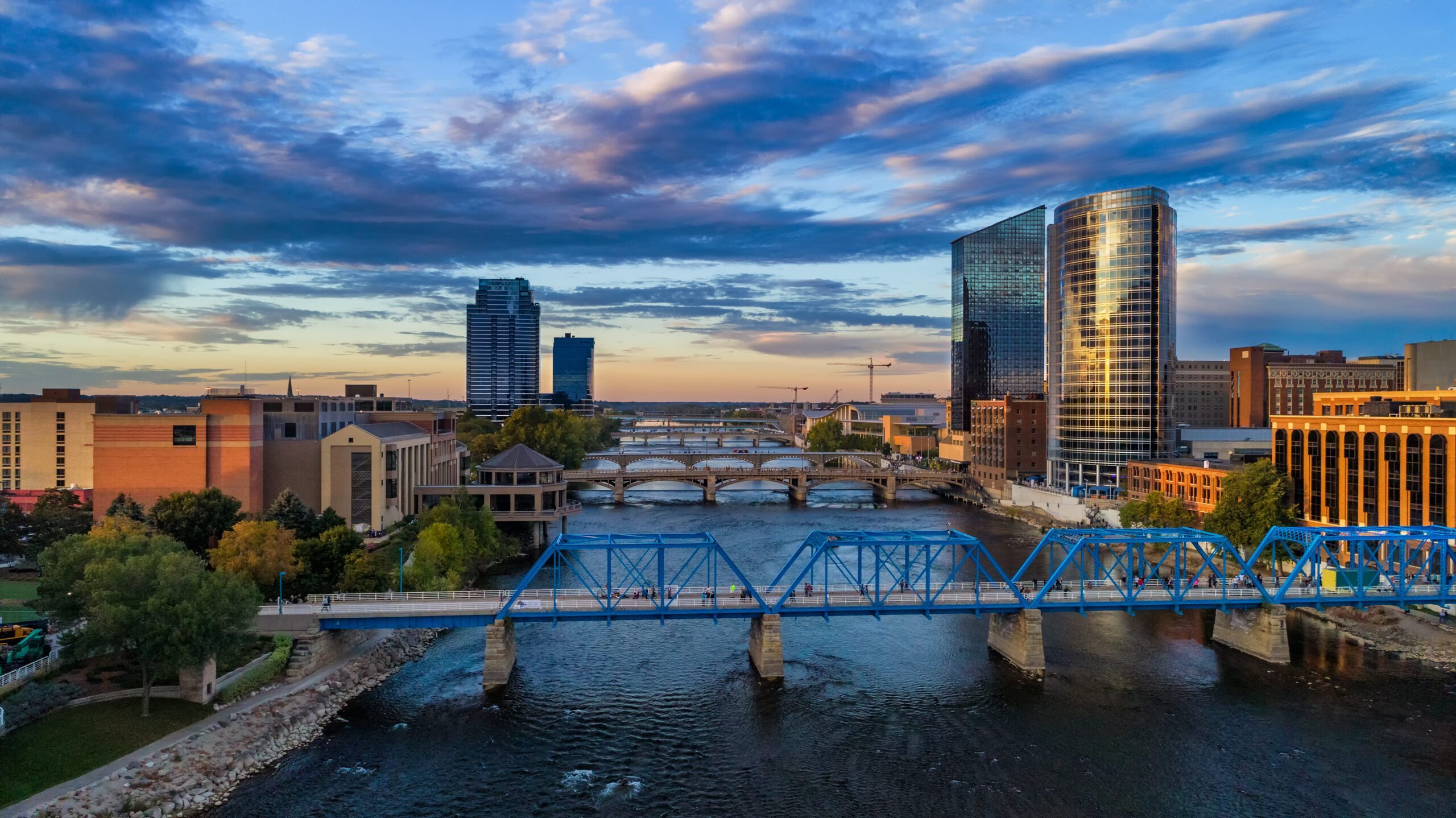
Farmington is easy to confuse with the much larger Farmington Hills that surrounds it on every side, but the two are separate cities with very different commercial footprints. Farmington itself covers barely more than two and a half square miles, and its entire commercial identity runs along a short stretch of Grand River Avenue through a genuinely walkable historic downtown, a rarity in this part of Oakland County.
That distinction matters for an exchange buyer comparing tax bills, zoning authority, and even street maintenance schedules, since a Farmington address answers to its own city government rather than the much larger one next door.
A Downtown Built for Foot Traffic, Not Drive-Through Lots
Grand River Avenue and Farmington Road converge downtown into a compact grid where storefronts sit close to the sidewalk and parking is shared and municipal rather than attached to each individual building. That layout keeps national chains largely out and independent restaurants, boutiques, and service businesses in, which is part of why the annual Founders Festival and a steady calendar of downtown events matter more here to leasing than they would in a typical strip-retail suburb.
Property Types Common to Farmington
- ground-floor retail and restaurant space along Grand River Avenue
- upper-floor office and residential units above downtown storefronts
- small multifamily buildings on the streets just off the downtown core
- professional office serving law, financial, and medical tenants
- a small amount of light industrial and flex space near the rail line on the city's edge
A City Too Small to Support Its Own Search
Because Farmington's entire commercial footprint fits inside a few blocks, a buyer trying to build a full replacement-property shortlist from Farmington alone will almost always come up short. We treat a Farmington storefront as a strong single candidate rather than the anchor of a complete list, and we start pricing Farmington Hills or Novi alternates the same week we begin the Farmington search rather than waiting for the downtown candidate to fall through.
Farmington Hills and Beyond for the Rest of the List
Farmington Hills, wrapping the city on all sides, carries a far larger inventory of office, medical, and retail product along Grand River, Orchard Lake Road, and the I-696 corridor. Novi, just to the west, adds newer retail and flex development around Twelve Oaks Mall and the I-96 interchange. Livonia, across the Wayne County line to the south, offers industrial and flex space at a lower basis for a buyer willing to trade a walkable downtown setting for square footage.
Diligence Specific to Downtown Farmington
Because so much of downtown Farmington relies on shared municipal parking rather than dedicated lots, a buyer should confirm how a given storefront's parking obligation is documented before assuming customers or employees have guaranteed access. Buildings along Grand River Avenue date to the early twentieth century in many cases, so lead paint and asbestos disclosures should be checked, and upper-floor residential conversions above retail space should be confirmed against current fire-separation and occupancy code before that income is counted in an underwriting model. Because the city is so compact, sewer and water infrastructure is generally older municipal-grade service rather than newer suburban lines, and a capital-improvement history should be requested from the city before a major buildout is budgeted.
Common 1031 Exchange Questions
Is Farmington the same market as Farmington Hills
No. Farmington is a small, separate city of just over two and a half square miles surrounded entirely by Farmington Hills, which is a much larger city with its own distinct commercial corridors along Grand River, Orchard Lake Road, and I-696.
Can I complete a 45-day identification list using only Farmington properties
It's unlikely given how small the downtown commercial footprint is. We generally treat a Farmington storefront as one strong candidate and build the rest of the list from Farmington Hills, Novi, or Livonia from the outset.
How does downtown Farmington's shared parking affect a retail purchase
Parking downtown is largely municipal and shared rather than dedicated to individual buildings, so a buyer should confirm exactly how a storefront's parking access is documented rather than assuming an informal arrangement will carry over after closing.
Are upper-floor residential units above Farmington storefronts a reliable income source
They can be, but fire-separation and occupancy requirements for mixed-use buildings should be confirmed against current code before that rental income is counted toward underwriting, particularly in older buildings converted from single-use retail.
Why would I choose Farmington over Farmington Hills for a 1031 replacement
Mainly for the walkable, event-driven downtown setting and independent-tenant character, which Farmington Hills does not replicate. A buyer prioritizing scale, national tenants, or a deeper inventory should expect to look at Farmington Hills instead.